
The Score Isn't The Game

The AI personal finance race is on. OpenAI can access your bank feed with permission. It’s a great start but nowhere near enough.
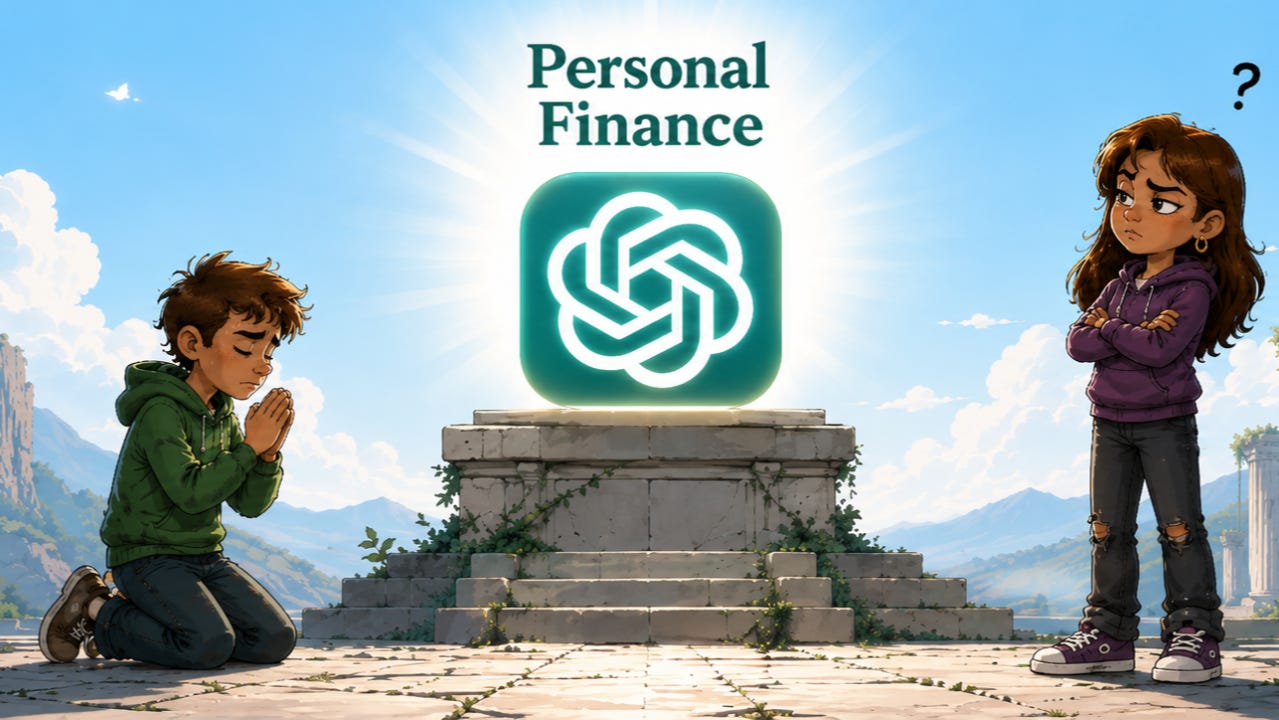
I love seeing innovation, progress, and the democratization of intelligent advice in personal finance. ChatGPT and Anthropic are making waves which shouldn’t be a surprise to anyone paying attention. The category needs more thoughtful capital, more product muscle, and more shots on goal. It’s too important to ignore.
But personal finance isn’t just about budgeting or tax planning. Society has shifted in a profoundly negative way over the past decade such that financial nihilism is more the norm than the exception. People don’t feel like they can successfully navigate today’s expensive world and many people believe it’s getting worse, not better. So let me say the uncomfortable thing out loud:
Connecting your accounts isn’t going to fix this.
Not even close.
And waiting for the government to fix it for you isn’t a strategy.
It’s hopium.
The Dashboard Trap
Giving credit where credit is due, the OpenAI / Hiro / Plaid integration is a real step forward. Seeing all your money in one place is genuinely better than logging into seven different apps and trying to keep a mental running total. The industry has been working on this problem since Mint launched in 2007, and a number of companies like Monarch, Origin Finance and YNAB are fantastic tools that millions of users love and use every day. ChatGPT will open up this functionality to tens of millions of new people over time which should be applauded.
But seeing your financial chaos isn’t the same as fixing it. It’s the equivalent of stepping on a smart scale every morning. The scale will give you useful data but it doesn’t make you healthier.
Aggregation tells you the score of the game you’re playing but it doesn’t change the game.
The Rule Followers Are Losing
Millions of people did everything they were told to do by getting the degree, taking the stable job, saving and avoiding dumb debt. They followed the playbook their parents handed them and ticked all the boxes society told them to.
These same people are frustrated that their effort hasn’t given them the prize they thought they were chasing.
Housing prices rose 48% between 2019 and 2024. Median income rose 22%. Childcare runs 3x what HHS considers “affordable.” Student loan repayment averages 20+ years and puts families behind on every major life event. The median 401(k) balance for Americans approaching retirement is a meager $65,000.
These are just facts. The numbers represent how much the social contract has changed.
I’ve been writing about this for a while and coined the phrase P(win) = 0 which is meant to represent the awakening people have when they believe the probability of winning is zero if they continue to follow the rules as they’ve been laid out. When they realize the math no longer maths because life became expensive and people’s incomes didn’t keep up. The conventional path stopped producing conventional outcomes a long time ago and people are frustrated that everyone keeps insisting the conventional path is the answer.
When P(win) = 0, any alternative becomes rational, even the ones that seem dumb on the surface.
It’s why 55% of Gen Z investors prefer crypto to the traditional financial ecosystem. It’s why Kalshi and Polymarket went from fringe to mainstream in eighteen months. It’s why 0DTE options trading has exploded. It’s why “save and splurge” lives in the same wallet at the same time. People aren’t being irrational. They’re being rational because they feel stuck inside a game they’ve concluded they can’t win.
Better Dashboard, Same Game
Now connect the dots with the new “connect your financial accounts” announcements.
If the underlying problem is that conventional financial advice no longer produces conventional outcomes for huge swaths of society, then aggregating bank feeds and pointing a large language model at the resulting dashboard gives you faster, prettier, more personalized versions of the same advice that already isn’t working.
Calling that democratized intelligent advice is generous. It’s democratized access to a playbook that’s convenient but outdated. It’s great directional advice that doesn’t actually help people address root cause issues. It’s a pain killer that makes you temporarily feel better.
But the truth is harsh. A better visualization of a losing position is still a losing position.
The Real Moat
I’ve written before that in a world where anything can be built in a weekend, the last real moat is an opinionated perspective on the solution. I believe this is more true in the personal finance category than almost any other.
Aggregation will commoditize and so will the model layer. The edge is going to live somewhere else entirely.
It’s going to live with whoever has a genuine point of view on what’s actually wrong and a framework for what to do about it that respects today’s realities rather than the realities of 1990.
That means saying out loud that the old playbook (”save 10%, retire at 65, 4% rule”) is structurally broken for a huge portion of the country. It means building an advice layer that takes today’s reality as the starting point:
The structural gap between income and cost of living is real and can’t be budgeted away
People need to live the lives they want to live now, not just plan for a hypothetical future
The goal isn’t perfect optimization. The goal is making the game winnable again.
That’s a product position. Most of what’s being built right now is a feature position. There’s a real difference.
Building It
Which brings me to what I haven’t really said publicly yet.
I’m building it.
I’ve spent the last year quietly putting together what I think the answer looks like. At its core, it’s an AI financial workspace built on a deeply opinionated framework I’ve been refining that starts with today’s reality. Everything I’ve been writing about for years is baked into the architecture.
It’s a fiduciary-minded decision engine that takes a position on what’s actually broken and gives people specific, actionable moves that account for the world as it actually is, not the world we were promised.
More to come when it’s ready (but we are hiring!).
I’m genuinely glad the big AI labs are wading into personal finance because the category has been underserved for decades and the work being done now will move the entire space forward. Real competition is good for users.
But the people who’ve been doing everything right and still aren’t winning don’t need another dashboard.
They need someone willing to say:
You’re not crazy. The social contract was rewritten so here’s how to play the game and win.
That’s what I’m building. Wish me luck.
Onwards and upwards,
Fintechjunkie