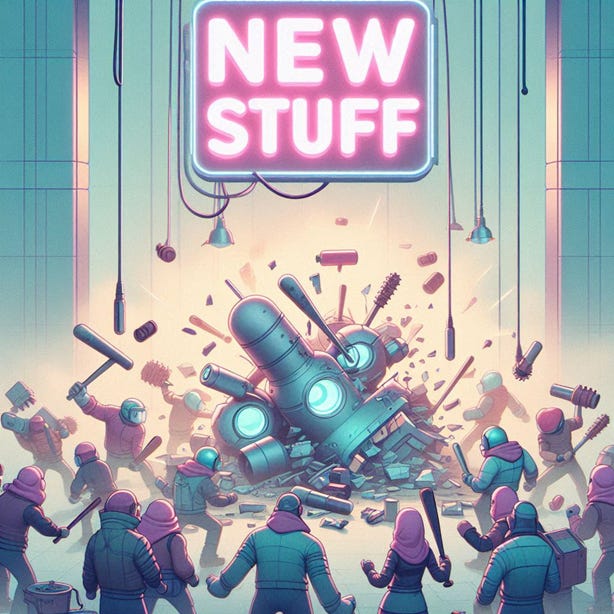
People Freaking Out About New Stuff

A quick skim of the top news headlines makes it abundantly clear that there are a lot of very vocal and powerful people that want to shut down all technological progress. And it isn’t just a few people here and there….it’s a movement!
(Pauses to look at the headlines. Sees article about the Longshoremen. Continues writing.)
So, buckle up because we’re about to take a wild ride through the annals of history to prove that the headlines just represent the “same backwards attitude focused on different new stuff.”
The OG Tech-Haters: Luddites
Even though we could go back farther in history to find famous technology deniers, about 200 years some of the most active OG tech-haters that history has ever seen decided to take matters into their own hands.
The Luddite movement, far from being a simple case of machine-breaking, was a complex socio-economic rebellion that unfolded in the early 19th century England. Named after the possibly mythical Ned Ludd, the Luddites were skilled artisans – primarily textile workers – who found their livelihoods threatened by the rapid industrialization of their craft.
The Industrial Revolution brought mechanized looms and other automated machinery that could produce textiles faster and cheaper than human hands. This technological shift wasn’t just about efficiency. It fundamentally altered the social fabric of manufacturing communities. Skilled craftsmen who had spent years perfecting their trade suddenly found themselves obsolete, replaced by machines operated by unskilled workers.
The Luddites’ resistance wasn’t merely about destroying machines; it was a fight for their way of life. They saw the new technology as a threat not just to their jobs, but to the quality of goods produced, fair wages, and the entire structure of their communities. Their actions included:
1. Organized raids on factories, destroying machinery worth thousands of pounds.
2. Sending threatening letters to factory owners and government officials.
3. Holding secret midnight meetings to plan their activities.
The British government’s response was severe. They made machine-breaking a capital crime and deployed thousands of soldiers to quell the uprising. And in 1813, seventeen men were executed for Luddite activities.
While the Luddites ultimately failed to stop industrialization, their movement left a lasting impact. It sparked debates about workers’ rights and the social implications of technological change that continue to this day.
But the Luddite movement wasn’t the only one to emerge from society in the past 200 years. There have been MANY rooftop shouters about MANY new technologies. And guess what they have in common? Failure.
Take for example the complete hatred by technology deniers for computers. Let’s call this “The Computers Will Eat Your Soul” movement.
The 1960s Deniers
The fear of computers leading to mass unemployment wasn’t just idle speculation. The introduction of mainframe computers in businesses and government offices led to genuine concerns about job displacement. A 1961 Time magazine article titled “The Automation Jobless” predicted dire consequences for the workforce.
However, what actually happened was a shift in the job market. While some jobs were indeed automated, entirely new industries sprung up. Computer programmers, systems analysts, and hardware engineers became sought-after professions. The rise of Silicon Valley in the late 60s and early 70s created an entirely new economic ecosystem.
The 1980s Deniers
The “Video games will rot your brain” campaign was more than just parental concern. It actually ended up being a full-blown moral panic! In 1982, Surgeon General C. Everett Koop claimed video games were producing “aberrations in childhood behavior.”
Critics argued that games promoted violence, stunted social development, and were addictive. This led to attempts to regulate arcade games, with some towns banning arcades altogether.
Fast forward to today, and we have a $159 billion global video game industry. Games are used in education, cognitive therapy, and even surgical training. The rise of esports has created a new category of professional athletes, with tournaments offering multi-million dollar prize pools.
The 1990s Deniers
The “Internet is just a fad” sentiment was surprisingly widespread, even among tech leaders. In 1995, astronomer Clifford Stoll wrote in Newsweek, “The truth is no online database will replace your daily newspaper, no CD-ROM can take the place of a competent teacher, and no computer network will change the way government works.”
Even more famously, Robert Metcalfe, the founder of 3Com and inventor of Ethernet, predicted in 1995 that the Internet would “catastrophically collapse” in 1996.
Today, with over 4.6 billion active internet users worldwide and its integral role in global commerce, communication, and culture, these predictions just make us laugh.
Enter the AI Alarmists
And now, drumroll please, we have the AI deniers. They’re convinced that AI is:
a) A power play by the technological elite that will make them richer
b) A weapon that will be used by liberals to control “the truth”
c) Cheap labor that’s going to take everyone’s jobs
d) The apocalypse in binary code
Their arguments range from “It’s advanced censorship” to “The robots will use us as batteries!” (Thanks, Matrix).
But the reality of AI is far more nuanced. While it does pose legitimate concerns about job displacement, privacy, and potential misuse, it also offers unprecedented opportunities in healthcare, scientific research, education, and more.
The Inevitability of Progress
Here’s the kicker: Technology doesn’t care about our feelings and it absolutely will not stop.
But here’s a wild idea: Instead of throwing digital shoes at AI, what if we… used it? Shaped it? Made it work for us?
Crazy, right?
The truth is, AI is here to stay. It’s not going to replace us; it’s going to augment us.
So, to all the AI deniers out there: History called. It wants its overreaction back.
Instead of fear-mongering, we need to channel our energy into ensuring AI benefits humanity. We need to use it to solve real problems, like climate change, disease, and why we still can’t fold fitted sheets properly.
Remember, every generation has its “end of the world” technology. And yet, here we are with devices that can translate every language in the world in real time, being chauffeured in self-driving cars and ordering pizza with our voices.
The future isn’t something to fear. It’s something to shape. So we need everyone to put down their digital pitchforks and pick up keyboards. The AI revolution is coming, and it won’t stop for Longshoremen, Climate Activists, or even Katy Perry.